
Hindes Hounds April '26 Newsletter
Hello, and welcome back,
I thought it was time I wrote properly again.
It has been rather too long since I last produced a newsletter, and in the meantime life and work have carried on doing what they do best: filling the days with dogs, clients, questions, observations, and the occasional reminder that real life rarely behaves as neatly as theory would like.
One of the reasons I wanted to restart this newsletter now is that I am in the middle of writing my book. It is taking shape steadily, and as I work through it I find myself returning again and again to the same concern: there is no shortage of dog advice in the world, but there is still a great deal of confusion. Owners are often trying very hard to do right by their dogs while being pulled in different directions by strongly expressed views that do not always join up clearly in practice.
That troubles me, because real dogs do not live in slogans. They live with us in kitchens, gardens, hallways, cars, vet visits, muddy walks, awkward moments, lovely moments, family routines, and all the untidy reality of ordinary life. Good guidance needs to survive there. That, in many ways, is what I am working on in the book and what I suspect this newsletter will increasingly reflect: not another camp to join, but a calmer, clearer way of thinking about dogs, behaviour, relationship, welfare, guidance, and daily life.
A small note from home: my female Tibetan Mastiff, Tashi, has had cruciate surgery, so we are currently in the rather unglamorous world of recovery management. She is doing well, though at present she is sporting what can only fairly be described as a chicken leg, and has taken a distinctly selective view of her allocated exercise. She is, however, perfectly content to rotate between a selection of soft beds, a little sunbathing in the garden and pack-car outings to sniff up the countryside as part of her daily stimulation.
My husband made indoor and outdoor pens especially for her recovery, which has been a great help, and she seems to regard them not as a confinement areas but as a private convalescent suites. Yogi, my male Tibetan Mastiff, meanwhile, has taken his responsibilities toward her very seriously and is busy guarding her, which will make perfect sense to those who know Tibetan Mastiffs and may sound slightly theatrical to those who do not. That is when he is not sneaking into her convalescence suite and stealing her cosy bed!
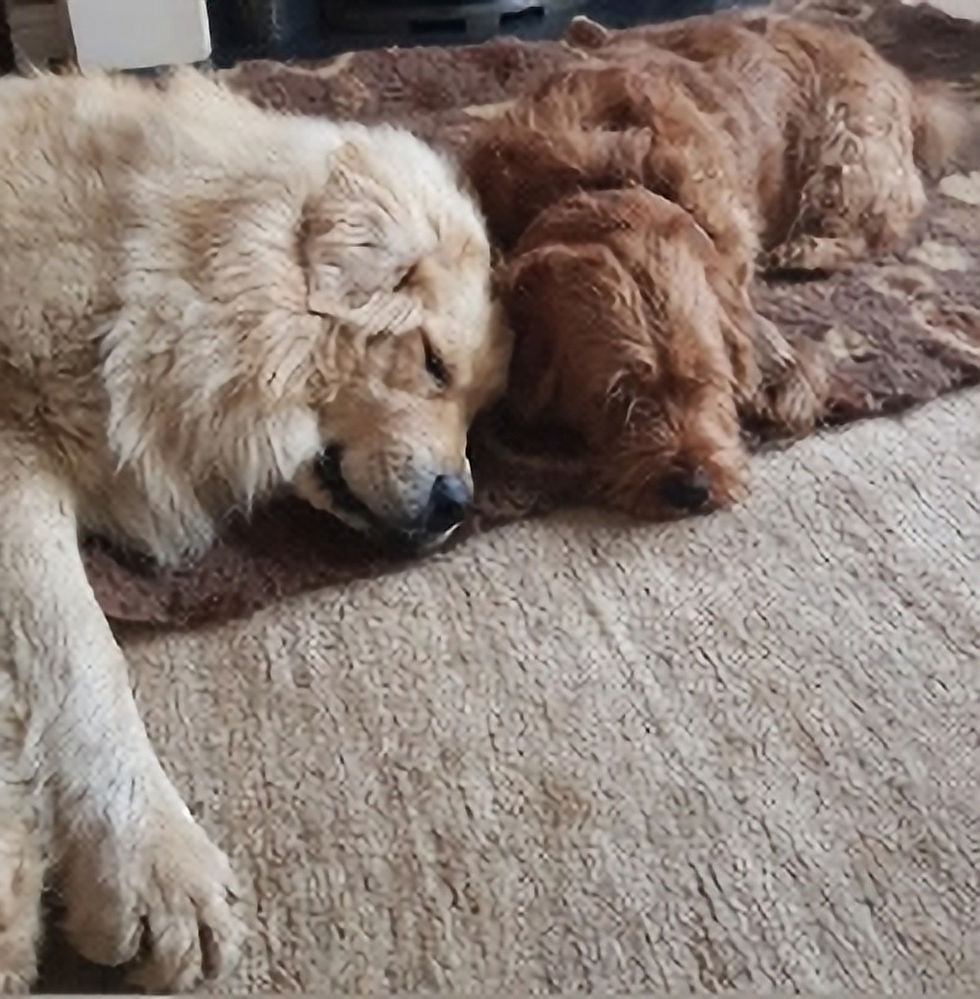
The boys, Yogi and Scrumpy (the latter my Basset Fauve), by contrast, are trundling about together like ‘Laurel and Hardy’, showing my age a bit there! They appear to be enjoying each others company and not missing too much the temporary absence of ‘Bossy Pants’ from their usual arrangements.
I have been flat out working as well, so the juggling has been a little relentless at times, but it is hard to complain for long when I come home to a gentle trundle with or a hug from the furry crew.
Work-wise, I have had some wonderful and really committed clients lately, and as so often happens, they have reinforced something I think is easily lost in the noise of the wider dog world: progress often begins not when we find the loudest answer, but when we slow down enough to ask better questions.
What is this dog actually showing me? What pressures are in play here? What has this dog learned? What am I bringing into the interaction? What is fair to require? What is likely to help not just today, but over time?
Those questions are not glamorous, but they are often where the real work starts.
If there is one useful thought I would leave you with this month, it is this: when things feel muddled with your dog, resist the urge to reach first for a label or a slogan. Try instead to return to the dog in front of you, the context around you, and the relationship between you. Clarity very often begins there.
Going forward, I expect these newsletters will be a mixture of reflection, practical thought, case-based observations, dogs at home, and the occasional note from the book as it develops. I do not want them to be dry, and I do not want them to be fluff either. Ideally, they will be useful, honest, and pleasant to receive with a cup of tea.
Thank you for being here.
Warmly,
Pamela
Hindes Hounds – Canine Behaviour & Training MUTT – Mutual Understanding & Trust Training


Comments